
CAA Artist-In-Residence: Erez Dessel – Gestural Mapping
By Erez Dessel, CAA Artist-in-Residence
How do we pass on the practice of creative music?
How does it move from generation to generation?
These questions have been my guide as I explore the Creative Audio Archive for this residency. I came up with them after being inspired by two great Chicago musicians, Ella Jenkins and Ajaramu. Ella Jenkins was a pioneer in the fields of folk and children’s music, collecting and performing songs in both idioms and leaving behind an illustrious body of work. Jenkins died in 2024 at the age of 100, and her last album was released when she was 93, the same year she received the NEA’s National Heritage Fellowship recipient. She recorded over 40 albums during her lifetime. Along with an incredible legacy as a performing and recording audience, what struck me most about Jenkins was her commitment to the passing of music, how can we keep it alive and move it around as a living entity. Her focus on working with children drives home the point that music, no matter how disparate, always has the ability to connect with people across all ages, backgrounds, and walks of life.
Ajaramu was a legendary drummer whose musical life was steeped in the Chicago jazz tradition of the 40s and 50s before he made the shift to creative music in the 60s with the creation of the AACM. He was there at the very start of the AACM, serving as Sergeant at Arms and Business Manager, all while writing and performing in this new vein of music. In an interview from 1977, Ajaramu mentions two things that felt relevant to this residency, the first being that he believed creative music would only truly flourish if it were given the basic promotion and support that many other styles of music were given. Secondly, he notes that the AACM had made serious efforts to open a school focused on creative music (and discusses what that school would have looked like), but had been met with paltry institutional support and derision from foundations. Reading about the AACM’s educational efforts piqued my interest, and helped me to frame how I’ve approached this residency.
When I first moved to Chicago in 2022, I saw as much music as I could, enraptured by the artistry on display in every corner of the city. I wasn’t playing out yet, so I had a lot of time to digest what I heard, and later go home and practice with it. I felt seriously intimidated by what I was hearing, lost at the prospect of learning how to improvise at such a high level. Still, I was working to develop my approach to improvised music, and was trying to distill some of what I heard at shows into approaches I could workshop at home in pursuit of the music. Eventually I developed the idea of gestural mapping/transcription, something that I derived from the concept of model composition (using an existing composition as a model to create your own composition with elements of the model). I see this idea as a potential answer to the question of how to pass on the practice of creative music. This process is by no means meant to be reductionist, rather, it is presented here to expand our world by providing access points with which to engage with this music.
I began to work with gestural transcription with the goal of finding a full thread of thought/practice from a show to the practice room. I wanted to be able to take some of what I saw live back to the piano immediately, and I wanted to be able to manipulate the material that I saw live. The idea is simple, I went to creative music shows and transcribed what I heard, focusing primarily on aesthetics, orchestration, texture, form and duration. I focused on hearing a performance in discrete pieces, phrases, and forms. For example, Roscoe Mitchell’s performance of “Nonaah” in Willisau in 1976 could be generally gesturally mapped as:
– Short angular phrase, played with brief space in between, played with a harsh insistence, repeat for an extended amount of time.
If you were at this concert and took note of this, theoretically you could go home and work on that concept, thus learning something for use in your own language without needing to fully transcribe exactly what Mitchell played. Another example, the Amina Claudine Myers song “The Real Side” could be mapped as:
– (A) Sparse soft unison chords
– (B) Drone-like vamp, groove, solo over top
– (C) Lose time, continue soloing
– Alternate between (B) and (C)
– (D) End with quick unison hits and chords similar to (A)
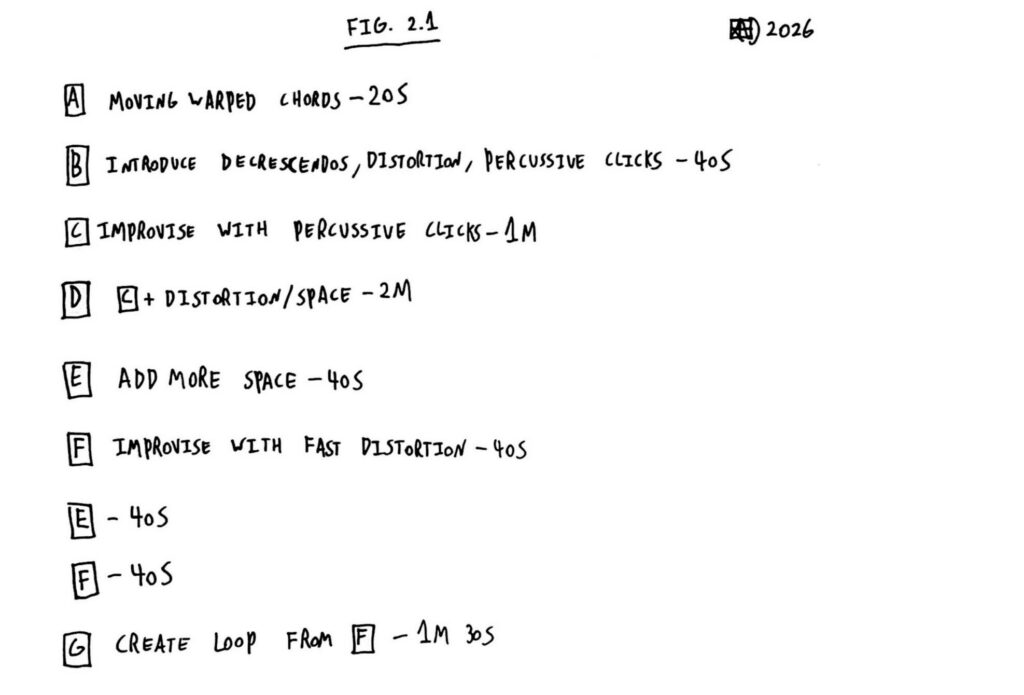
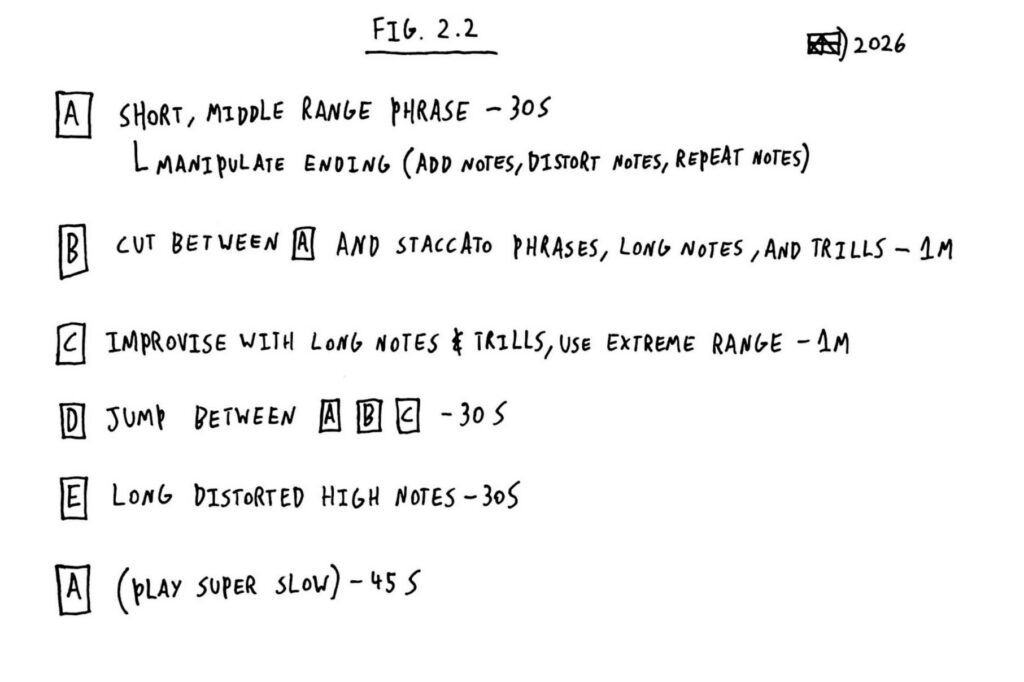
Again, this is not meant to be hyper-accurate, this is a system meant to be implemented during live shows (or with recordings), so the point is to get a general sense of how the music is moving (and use language that makes sense to you!). The practical applications afterwards are also up to you, some things that I’ve found helpful include practicing a complete solo performance of a gestural map, focusing on one technique from the map, and using a map to compose, either as a complete model or with re-ordered parts. For this residency, I’ll not only be exploring the Creative Audio Archive, but also making gestural maps of recordings in order to activate the archive and expand its use for musicians, educators, and anyone interested in creative music. The maps are simple enough to interpret, they contain rehearsal marks (for ease of use and reordering of material), a description of what to play, and a duration (in minutes and seconds). What’s scored in these maps is based on the recordings, but they are living scores, and should be viewed as a jumping-off point for creative artists.
Scroll to the bottom of the page to listen to each recording as you read through Dessel’s analysis and Gestural Maps
SR-R082, SR-R083, SR-R084 – Sunny Reels
SR-R082 – Sunny Reel #1
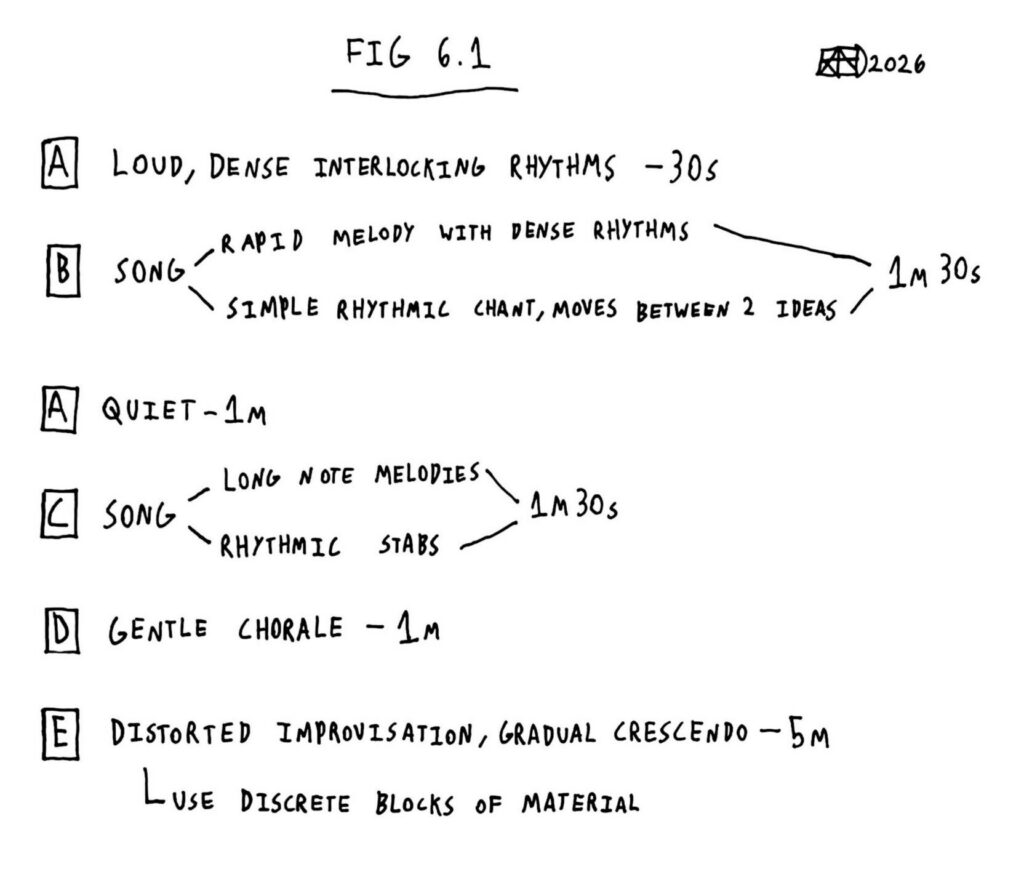
(Fig 6.1)
If there was ever going to be a dedicated anthem for the world of creative music, my vote would go to the opening song from this recording, “Somebody Else’s Idea”. This piece was my very first foray into the world of creative music, taught to me by Joe Morris in 2016, and it will always hold a special place in my heart. The lyrics are sublime and somewhat didactic, quite literally spelling out the ethos of creative music as a way to look at the world through multiple and deeply personal perspectives. Even the technical musical aspects of the song represent some grand truth about creative music, the background vocals repeat a basic, catchy chant, while the main melody follows the inherent rhythm of the words, giving it a beautiful off-kilter rhythmic balance. The simple and the complex exist as one, and above all, the song revolves around individual truth composed within the collective spirit.
Taken as a whole, this recording navigates multiple landscapes and what I hear as a propulsive conjuring effect, each new section seems to be pulled from thin air, but with a distinct energy that flows throughout the recording. A cacophonous drum solo settles into “Somebody Else’s Idea”, but the pensive melody quickly gives way to a loping instrumental, gently swinging but with Ra’s signature explorations throughout. He’s so dedicated to contrast, and manages to sneak in some keyboard just before the drums drop out and the horns enter a plaintive chorale section. Again, forward momentum reigns supreme, and keyboard enters again to clear the air, quickly building to a frenzy with the drums. The range is astonishing, but again we only need to think back to the opening lyrics to remember that this is the name of the game, this is Ra’s idea of the world, and though you may not agree, you cannot argue against its unbridled authenticity. I love how at this point, midway through, we really reach a settled groove, though not in the traditional sense. It’s distortion matched with distortion between the drums and keyboard, but I hear a moment like this as containing a staid sense of flow. All parties are intently dedicated to maintaining a high level of energy, but with a certain lack of contrast that makes the listener investigate how range can be explored in a high density moment. As the music continues, Ra investigates density further, manipulating his material in discreet blocks and maintaining a mentality of construction throughout seemingly deconstructive musical zones.
SR-R083 – Sunny Reel #2
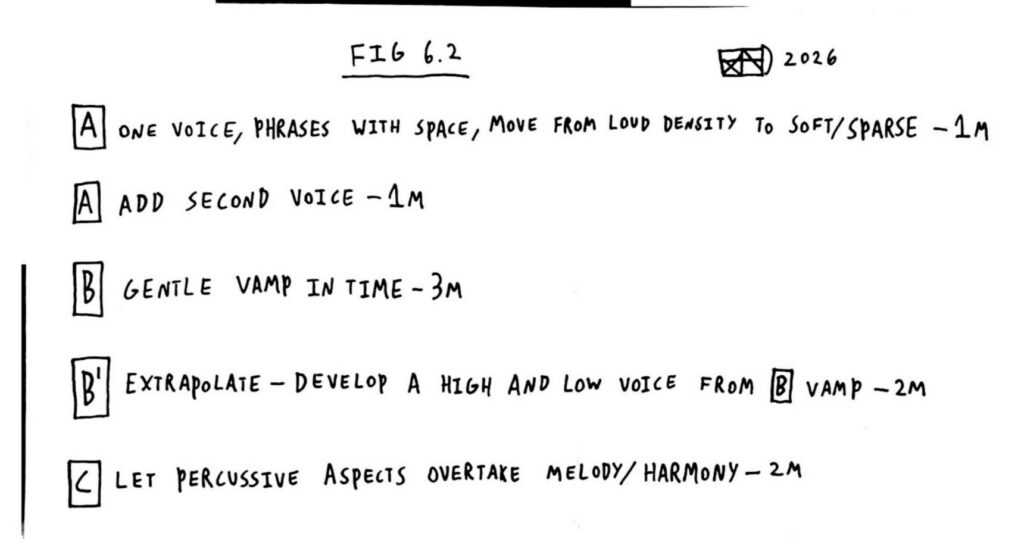
(Fig 6.2)
Here we get another look at “Somebody Else’s Idea”, though this version is gentler, and there’s a different kind of contour happening within the group. The way a band can slowly expand or contract an idea is a beautiful thing, and with a large ensemble, that breathing quality is only amplified. Even though this is just a snapshot of a larger set, we can still hear an interesting crossfade effect happening, essentially swapping density for orchestration. The music starts with propulsively dense solo piano, but Ra quickly floats down to Earth and ushers the band to join him in delicate song. The piano becomes dissipates as the music continues, eventually Ra even switches to a simple organ bass line, quietly slipping out to allow the percussion to take over. There’s somewhat of a parabola here, as we go from dense solo instrument, to sparse ensemble playing, and finally back to density with multiple instruments of the same family, which maybe obscures orchestral distinctions between solo vs. ensemble.
SR-R084 – Sunny Reel #3
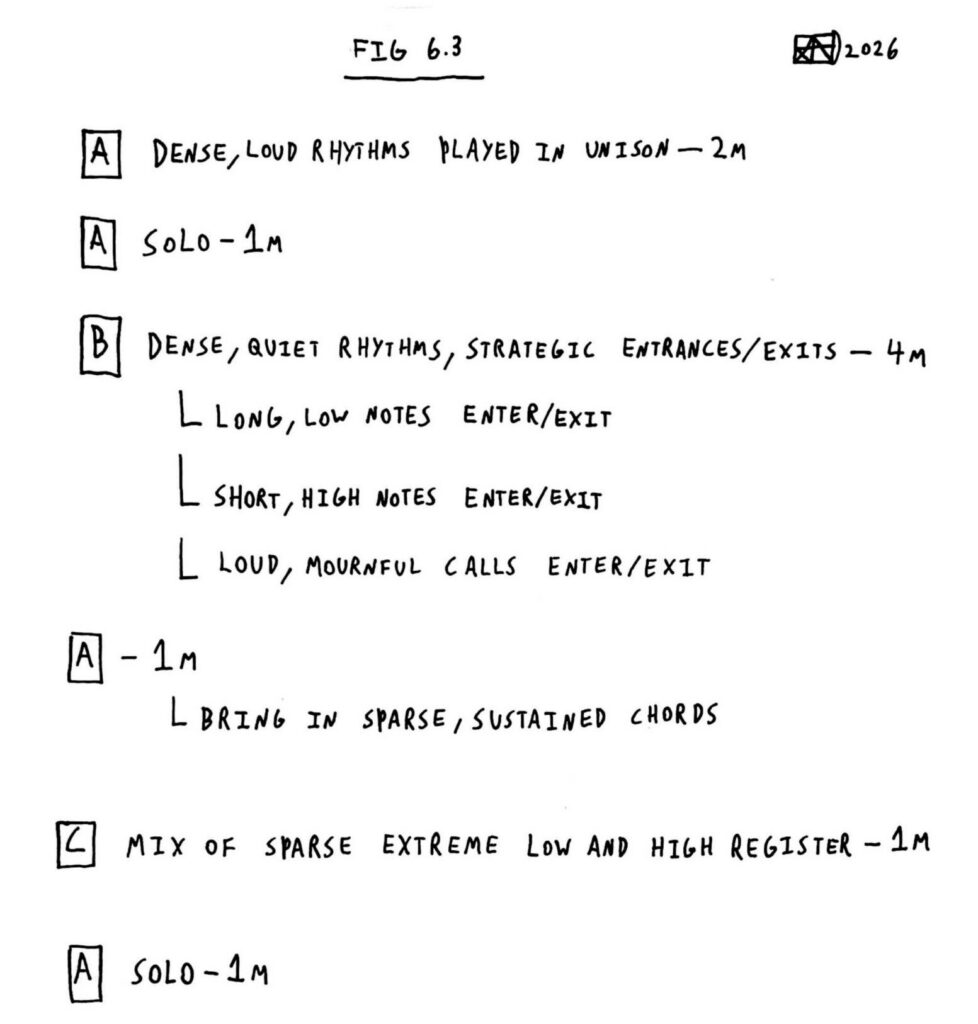
(Fig 6.3)
A fascinating way to look at this recording is through the lens of pure rhythm and pulse. We begin with a unison rhythm being orchestrated in two different ways, with percussion and saxophone. This breaks down to a thinned-out, solo version of the same rhythmic space. A quick transition enters us into an open, event-based zone with various lengths of notes and lengths of phrases gradually entering and leaving. There is a slow sense of interplay here that really emphasizes time, things feel orbital rather than linear. The band develops this space for a while, skewing the proportions of the music and making it all feel slightly entrance/exit-based. Eventually, we return to the same orchestration as the first section, with one player playing the same rhythm as before, and the other players developing the orbital texture. A strange apex is reached when both players return to the first section just as Ra brings in a new rhythmic grid extremely slowly, forcing a rift in the pulse. We’re treated to a masterful example of a truly pianistic technique, using the instrument in a way that pushes against its sonic boundaries. Ra uses range and timbre to draw out rhythm from the piano, all while increasing in speed and intensity. His playing seems to distill the band into the keyboard, an example of the collective energy transfer that was intrinsic to the Arkestra.
Working on this gestural map made me realize what a compelling adventure in experimentation or performance this recording could yield. Even though it’s a fragment of a longer performance, there’s an acute mix of openness and structure present, and if one were able to work on playing this map, I believe it would yield interesting results. This mix of openness and structure is something that I find present in much of Ra’s later music, as well as creative music as a whole. The ability to create and wield simple ideas in the micro into a more complex or abstracted structure in the macro seems to be inherent in our music. Furthermore, having a good grasp on this relationship can allow a musician with limited ideas, or someone new to improvising, to use their creativity to extract maximum content from minimum material. Listening to this recording and thinking of it in terms of gestural mapping, I could hear these ideas going many different directions, and that’s exciting to me both as a performer and a listener. At some point, working with these systems probably leads to a surplus of material and ideas, in which case the game becomes about editing and refining, and how to sculpt the sound in the moment. That’s when improvising jumps from the realm of playing to truly instant composing.
SR-R094-A – Unidentifiable PN Part 1
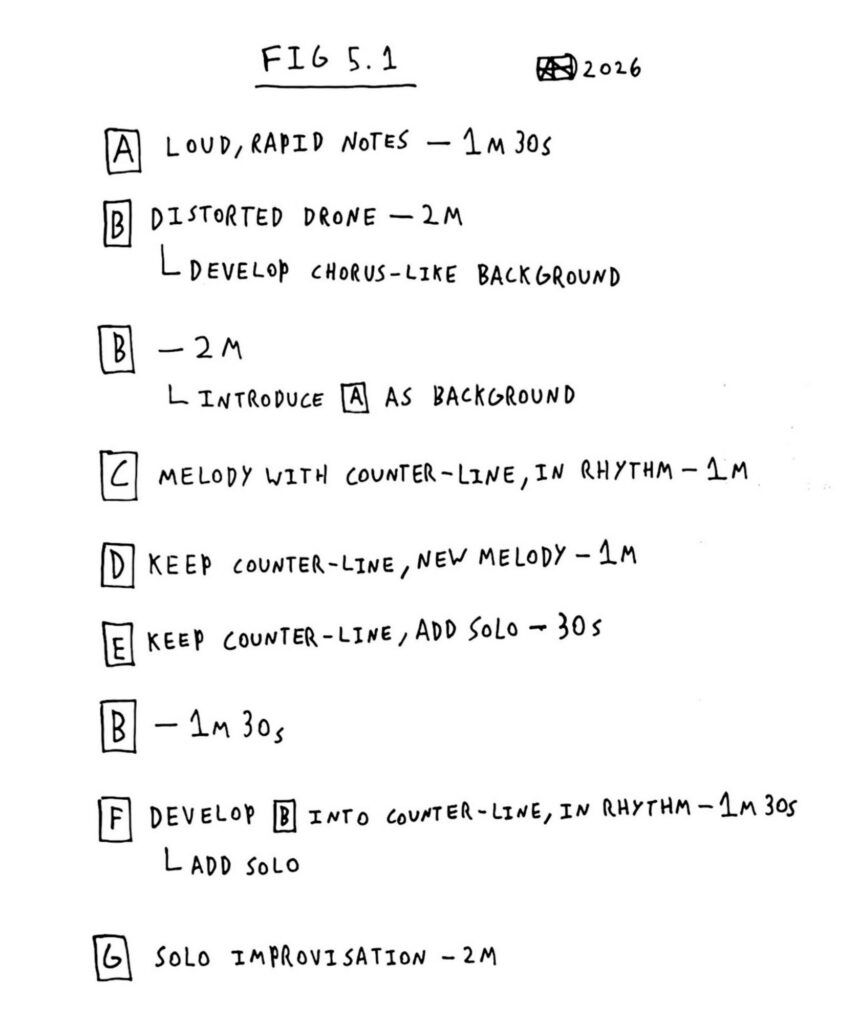
I always hear such fearlessness in Sun Ra’s music, and his fearlessness is always dynamic; sometimes it’s understated, other times it’s on full display like in this recording. I feel a real kinship to this music, partly because it was recorded where I grew up in Ann Arbor, but also because, as a pianist, I hear Sun Ra reaching and stretching beyond the traditional modalities of the piano. By 1969, when this recording was made, improvising musicians were ramping up the use of electronics in their palette, though it should be noted that this was usually led by pianists, and that Sun Ra was on the forefront of electronic experimentation within a jazz context. Here, I hear Ra pulling a sort of reverse-Ellington. The connection to Duke is obvious, but rather than have the piano play a subtle role, guiding the big band as Ellington often did, Ra acts almost in opposition to the rest of the band, attempting to overtake the large horn section and drummer from behind the manual. I love this approach and have an immense amount of respect for it. I hear no real antagonism in his playing, just a dedication to creating a very specific and new aesthetic. At this time, I think coming at the music with this much rawness and intensity hadn’t really been explored in jazz, and certainly not when combined with electronics and a large band. Still, it’s not all raucous sound on this recording, there’s juxtaposition and movement, and the band is always together in some way, whether chanting a call to planet Earth or bubbling up from within Ra’s dense keyboard maelstrom.
There are actually three recordings from this set in the archive, I would recommend listening to all three to get the full effect. You can hear the band swiftly move from drone, to swinging melody, to brash saxophone and drum solos, and then combine all those elements in endless permutations. I love how much space everything is given, there are a few melodies played by the band in time, but the saxophone is given open space to improvise at will, prodded by Ra’s clusters. The drums are given even more room to run, this set feels built around the percussion, and just when the solo might start to wind down, surging organ tones enter in an unexpectedly sonorous tonality, as if the sun is coming out after the rain, but too close and too hot. A soft count off can be heard starting the final section, a knotted choir underscored by ominous distortion, and when the piece ends, you can feel that the audience must be stunned by what they heard. The rest of the set snakes around, and I’m drawn to the interpretive powers of improvised music. Ra elicits guttural tones from his keyboards throughout the night, and I hear an echo of this in the saxophone solo, not in any contrived way, more like the Newtonian perspective that an idea set in motion by one musician will remain in motion by others. In fact, there is a sympathetic ring to the whole event, as this concert was a split bill between the Arkestra and seminal Michigan rock band MC5. I’m sure the Arkestra would have played the way they played regardless, but their approach pairs nicely with the proto-punk that would follow. Standing in the Ann Arbor Armory that night was surely an atomic experience, but for now these recordings will have to do for a taste of this interplanetary energy.
TA-049_Anderson-Drake-Parker-Aoki_Velvet-Lounge_01-15-1999
Looking at this lineup of musicians playing at the Velvet Lounge, I believe the most apt word to describe this music is ritual. A cursory glance at the CAA, particularly the collections of Malachi Ritscher, Fred Anderson, and Tatsu Aoki, will reveal how often this combination of players and venue met. I never met Fred Anderson, but the work he did as a musician and owner of the Velvet Lounge still resonates powerfully throughout Chicago improvised music scene. This recording excited me initially because of its date, recorded just a few days after New Years 1999. Though musicians often operate on our own cycles, the refresh of a new year affects us all, and I was curious how this group would sound with that in mind. The first thing we hear indicates the familiarity and comfort of the band’s approach, you can hear someone say “Let’s do that groove… that was nice… let’s start with that and kinda warm up”. What follows could be a groove they played a hundred times, or something that was just improvised while soundchecking, it doesn’t really matter, as one of drummer Hamid Drake’s strong suits is making a drum beat sound deep in the pocket from the first notes. One by one, the rest of the band joins, there is a real omniscience in how they enter, again driving home the themes of familiarity and ritual with their playing. On this set the band is following those first instructions of “Let’s do that groove”, and led by Drake’s drumming, focus on the rhythm initially. Aoki’s bassline is driving and catchy, Parker starts with a nice middle ground of rhythmic clusters, not soloing but not quite comping either, and as Anderson enters, where you’d expect melody, there’s only more rhythm. His focus on playing with his bandmates is palpable, there’s no hierarchy or agenda beyond entering the flow that’s already around him.
To me, this group hits on a sound that is emblematic of a specific musical aesthetic, the sound of Chicago creative music in the late 80s, 90s, and 2000s. Anderson, Drake, Aoki, and Parker were respectively 70, 44, 42, and 32 at the time of this recording, a multi-generational band that allowed for a crystallization of the music at the turn of the millennium. It’s a little hard to put into words, it’s something about the mix of more standard forms and rhythms with a free approach to harmony and melody, and an overall focus on how the micro and macro aspects of sound function during improvisation. There are still common operations occurring, in this set we can hear group improvisation taking the place of a melody, with the band breaking down into individual solos much the way jazz musicians would operate. However, there’s more fluidity, the actual content is wide open and there’s a dedicated sense of balance between improvising and maintaining functional song form. To my ears, this kind of concerted effort in improvising song, the attitude of “we WILL improvise but there WILL be song-like cohesion” stems from the AACM and their incredible ability to pull from the widest sonic palette available when composing and improvising. Even the early days of the AACM indicate this eventual direction, the experimental band’s core belief in members writing original music probably ran the gamut from standard jazz tunes to extremely avant-garde concepts, so musicians had to be able to realize and perform the link between such disparate aesthetics.
To bring things back to this recording, I’ll point out a few favorite moments. Around the 20-minute mark, Hamid Drake takes a wonderful solo that puts all the elements of creative music into play. The band was previously in a swing section, which broke down to a bass solo and an eventual loss of pulsed time. I hear Drake astutely observing that and beginning his solo at the antipode of swing, choosing to start with small/soft/light/discreet sounds that flutter rather than lope. The solo gains heft from the introduction of a low drum and shaker, and in a nice misdirection, moves back to dynamically light sounds while increasing the density of material. This material builds in both volume and pulse, Drake is really rolling now, and the interplay between limbs is staggering. Eventually we get another great sleight-of-hand moment, as the solo concludes and you’re sure the band is going to come in, the drums begin pounding out a steady quarter note pulse that’s stark in comparison to the previous material. This redirection of energy, especially in the midst of a lengthy set, is brilliant, it’s an invitation to use the energy built up during the solo but take it in a slightly different direction, a truly improvisatory take on orchestrating the flow of the band. I’ve neglected to mention tempo when writing about this solo because it really eludes me, Drake’s manipulation and concept regarding tempo is too masterful to describe, early in the solo he’s using multiple tempos at once, and even once things get going in a pulsed time there are reflections, echoes, ghosts, hidden trapdoors, and an unbelievable bounce that makes his command of tempo supreme.
Another nice moment is at the 57-minute mark, Anderson brings in an incredibly simple two note riff, something more about rhythm than harmony or melody. The band immediately joins, and what follows is a beautifully organic exploration of this simple idea. Listen closely to Anderson here, the way he leads by example in working with this material is exciting to say the least, and the roughness and smear of his ideas brings a warmth to the energy of the music. This organicness/roughness/smear is another quality I would say is unique about Chicago improvised music at this time. Listening to the band move through this idea I can’t help but think how I would approach it, or how things have gone when I’ve been in similar situations. Most musicians would either hold onto the specific rhythmic riff too tightly, not allowing it to breathe, or leave it too quickly, seeking new material prematurely. Here, Anderson gently guides the music, facilitating the middle ground of exploring something small in a big and wonderfully loose way. Unfortunately, this was probably close to the end of the set and the recording gets cut off, but just the glimpse of this idea lifting off is enough to see how deep this band could go.
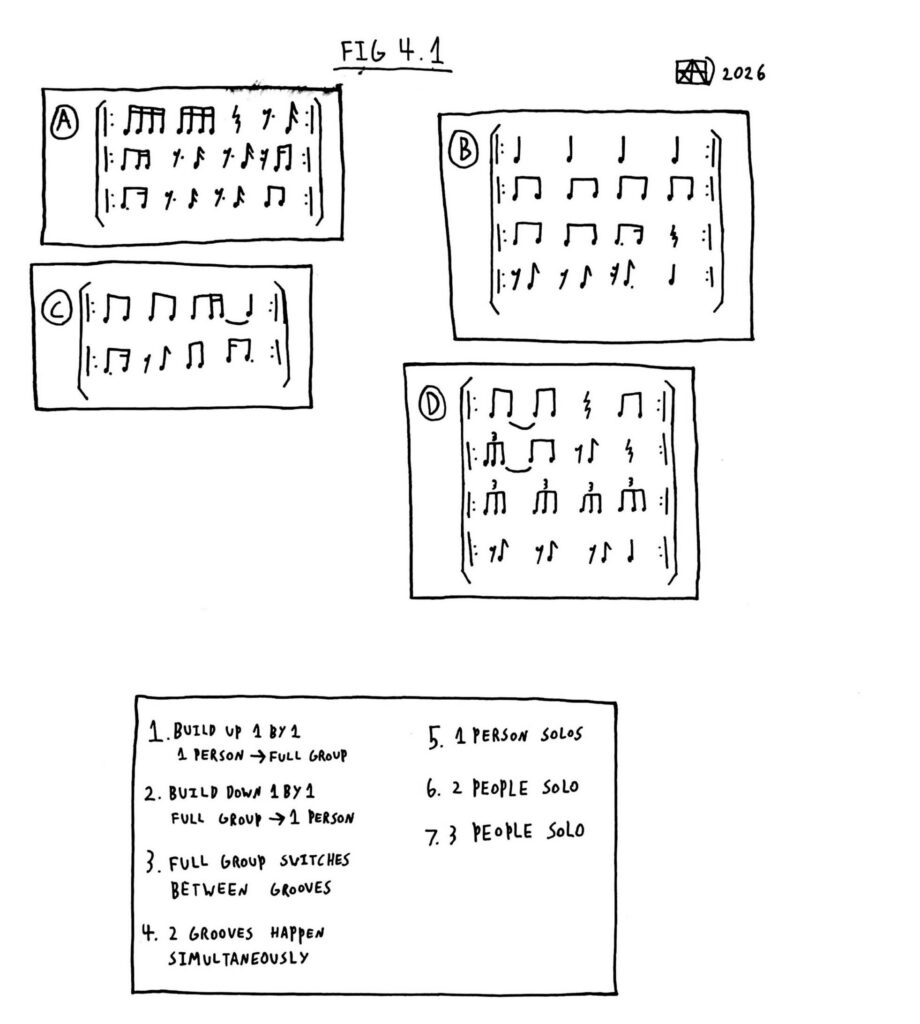
Coda: For this gestural map, I chose to lean into the band’s approach of taking rhythmic themes and manipulating them throughout the group. The letters at the top contain multipart grooves that can be played by a group or solo, the numbers at the bottom indicate operations that can be used to transition between the grooves. Using a combination of letters and numbers, a group or individual could develop their own concept of improvising using rhythmic structures as a starting or ending point.
SH-045_Cutler-Cooper-Parkins_Bard-Hall_12-17-1983, Side A
It’s gratifying to hear the results of group cohesion in an improvised context, and equally gratifying to know that cohesion sprung out of dedicated time spent working together with composed material. Lindsey Cooper and Chris Cutler crossed paths throughout the 70s and 80s in various “experimental” rock contexts (I never know what the word experimental is supposed to mean when it comes before the word rock), and around this time linked up with Zeena Parkins to create the band News from Babel. Listening to this set, I would never want to ascribe any genre to what they’re playing. Rather, I’d note a sense of play throughout their improvisation, and the fact that at any moment, you could imagine them stopping and trying to work a song out of the ideas they improvised. Good composition and good improvisation are one and the same, just on a different timescale. Here, the music is flowing, but the group is able to quickly get into a cohesive idea, and just as quickly transition to the next. Looking at this from the perspective of someone interested in how bands deal with composed versus improvised material (and the area in-between), it’s also interesting to observe how one musician in the trio often will really dig into a “part” in the moment. This strategy may seem like the antithesis of improvisation, but the ability to create a repeated texture and manipulate that texture to support the musicians around you is high-level improvising. In fact, what it really takes is thinking on two time axes at once. A player must be able to compose in the moment, but also remember what their fellow musicians played before, and use that to gain insight into what they might play next. Thus the composing and playing of a sympathetic “part” links up with the players around them, and enables the part to develop in time with the piece.
Coda: Researching these three musicians led me to the band Art Bears, where Cutler and Cooper briefly played together. It’s hard to find any definitive source, but it seems there’s some anecdotal evidence that Art Bears lifted their name from a line in the book Ancient Art and Ritual by Jane Ellen Harrison. The opening lines of that book is as follows:
“The title of this book may strike the reader as strange and even dissonant. What have art and ritual to do together? The ritualist is, to the modern mind, a man concerned perhaps unduly with fixed forms and ceremonies, with carrying out the rigidly prescribed ordinances of a church or sect. The artist, on the other hand, we think of as free in thought and untrammelled by convention in practice; his tendency is towards licence.“
These opening lines feel worth investigating in 2026. Specifically, in thinking about how creative music is passed from generation to generation, the idea of art and ritual being intertwined feels obvious and necessary. There has always been some aspect of ritual involved in the art I’ve seen, made, and been a part of, and that’s why I love art. Thinking about how Cutler, Cooper, and Parkins operated together, without knowing too much about this trio’s practice, I can imagine that their ritual went something like this: gather together (rehearsal), have the right objects in place (instruments), access some sort of mind/body space together (improvise), take note of what you thought/felt (compose). This formula is seen in ritual just as much as in artmaking, and I think it’s helpful to frame music this way, as something that can be used to access our innate humanity going back thousands of years.
LH-029_Ethnic-Heritage-Ensemble_1988-05-07, Track 3
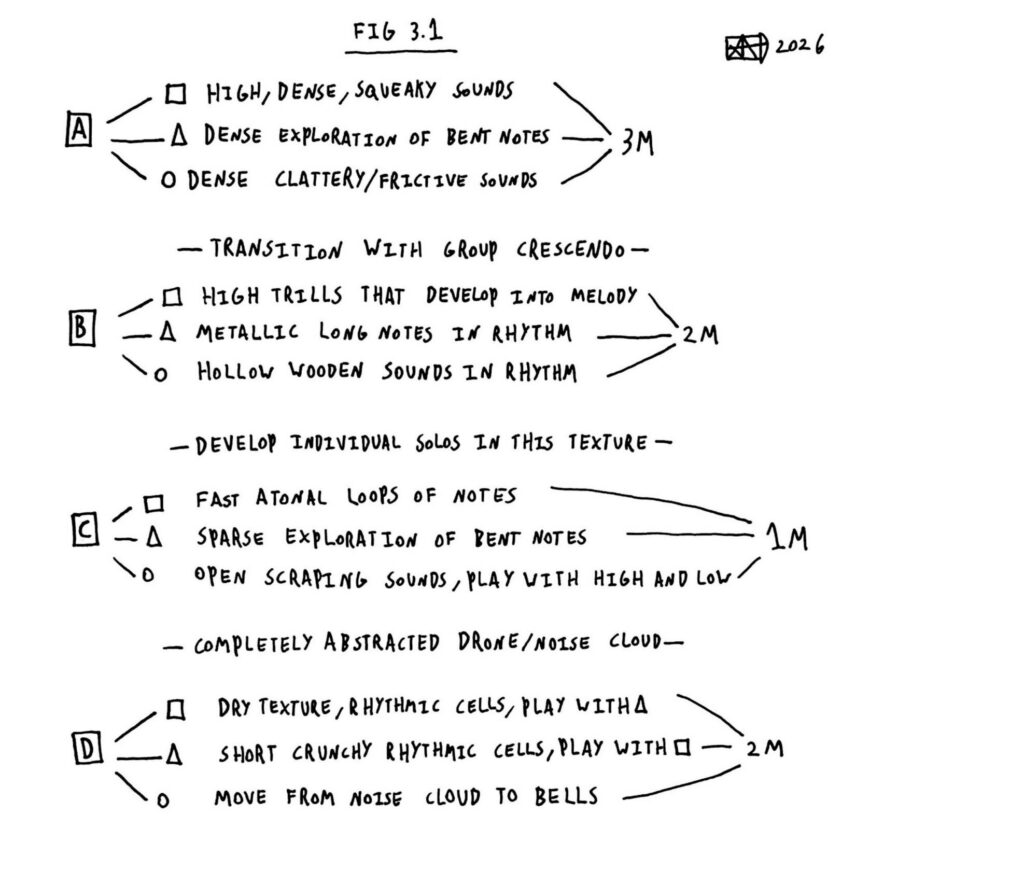
Track 3 (Fig. 1.1) The Ethnic Heritage Ensemble is one of my favorite trios to come out of Chicago, and one of the longest-running creative music outfits (it was originally formed in 1973, and its current lineup features Corey Wilkes, Alex Harding, and Ishmael Ali alongside the group’s leader Kahil El’Zabar). This early iteration of the band finds El’Zabar joined by Joseph Bowie and Ed Wilkerson Jr., a formidable group of musicians (Wilkerson Jr. is still with us and active in Chicago). My favorite thing about this group is how they’re able to create so much sound with only three people. I would posit that, like with most small groups, there’s a quantum effect occurring here, and their ability to play with and against each other is what creates the greater-than-the-sum-of-their-parts effect that contributes to their large sound. I think there’s also something to be said for the creation of a sound world, and how a commitment to aesthetic, when done with purpose, can aid in making the music larger than life. I hear a common thread throughout many of the group’s songs, but I’m never bored, instead the world they’ve built always feels inviting, with new rooms to discover and strange hallways to get lost in.
“An interpretation of street hipness, green dolphin style.” This is how El’Zabar describes the opener of this 1988 set at Links Hall. Jazz fans might recognize it as a reconstruction of the standard “On Green Dolphin Street” though from the jump it’s distinctly done through the Ethnic Heritage Ensemble lens. Take note of the opening, and how the train noise blends seamlessly with El’Zabar’s percussion intro (I wasn’t around to see the old Links Hall, though listening to these recordings it’s clear that the CTA featured heavily in most performances). The blending of external environment and band sound is important, it emphasizes the group’s careful ear and sense of space, and highlights how Chicago creative musicians really investigated sound in all its forms. The band gets things going with a simple two note vamp, though once the horns have locked in with the percussion, the depth of groove feels so unstoppable I could imagine the whole room felt they were a part of the vamp. El’Zabar’s vocalizations are a unique aspect of this ensemble, and again feel like something done in the name of environment, they never take center stage, instead forming a glue that fills the gaps between percussion and horns.
I love the way Bowie and Wilkerson approach the “tune”, shadowboxing and throwing light jabs rather than fully committing to a punch, but with a knowledge and playfulness that lets you know they could dance around each other all night. Again, sound is the priority here, Bowie’s gravelly trombone plays a perfect foil to Wilkerson’s high, haunting saxophone. Eventually, El’Zabar joins the melody as well, allowing Bowie to solo, and Wilkerson to wax and wane between the simple vamp and the more complex intervallic melody, bare structure but fertile ground for improvisation. Throughout all of this the percussion is an engine on the open road, nowhere to go but forward, all momentum and purr. Wilkerson moves into the spotlight at some point, taking a gorgeous solo. His voice is one of the most unique on the instrument, on this track it shifts between sounding like speech, clipped and phrase-like, and resting on the the groove, howling over the top of the trio. Towards the end, El’Zabar gets a solo moment, leaning into the drum in a way that makes his solo feel like an extension of the beat, as if these rhythms were there all along just waiting to burst forth. Like the trio itself, the palette is somewhat sparse, just bells and hand drums, but El’Zabar’s brilliance makes everything sing. We get another lilting rendition of the melody at the end, truly I’ve never heard the song played like this, in the best way, it seems that we’ve left behind any connection to the 1947 American songbook classic and are invoking a new sound. In a final moment of serendipity the band fades perfectly with another passing train, the environment wiping the slate clean, clearing the way for more music to be made.
LH-029_Ethnic-Heritage-Ensemble_1988-05-07, Track 12
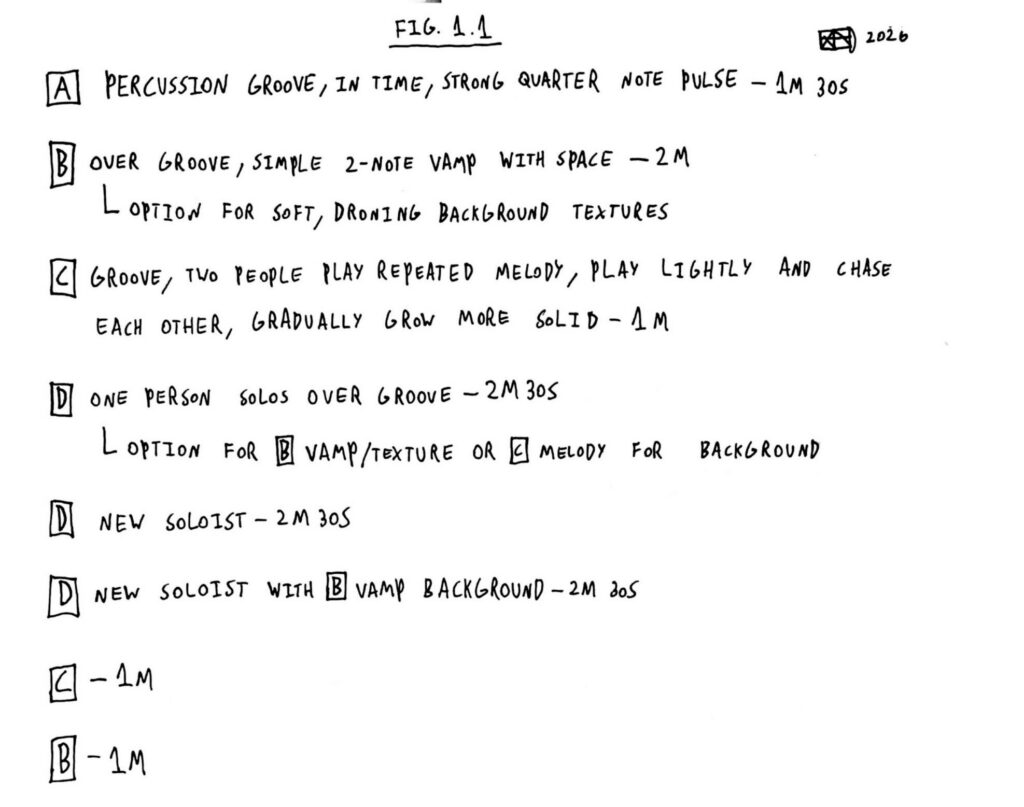
Coda: I want to give a special shout out to Track 12 (Fig. 1.2) in the name of environment. The first sound we hear after the applause dies down is a chair scraping the ground, seemingly incidental noise. However, ever the astute listeners, the ensemble grabbed on to that sound, and once El’Zabar’s bells and cymbals die down, we’re treated to an intricate creaking improvisation pitted against a whirly tube drone. Chair scraping, squeaking, someone stomping or knocking on the floor (?), an exploration of woody noises provides an unexpected intro to this song.
LH-005-C_New-Music-Chicago_1987-04-18 Tracks: 3, 7, 9, 11
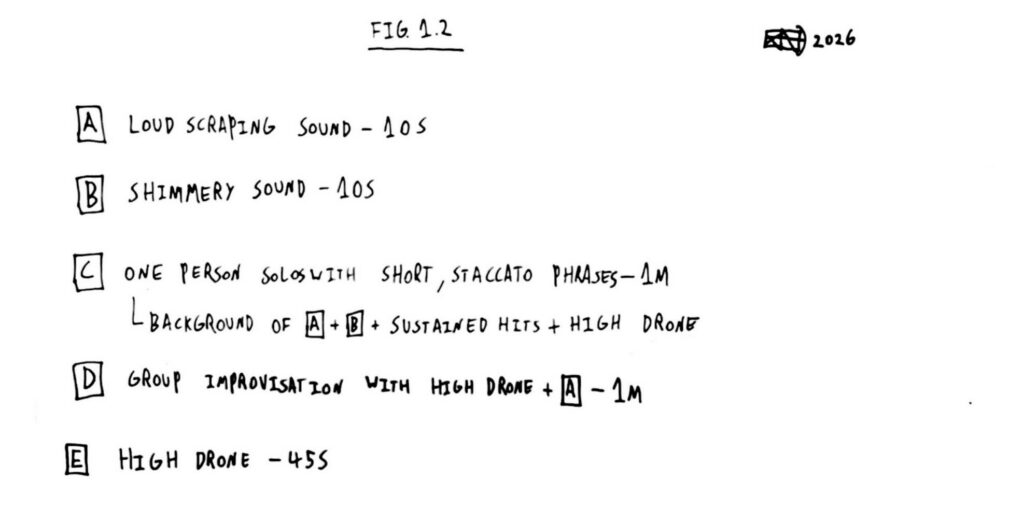
As an improvising musician, I feel that it’s important to be amenable to all types of sound/music sources, and I’ve often found new music to be a great source of inspiration. It was hard to pick just one piece from this concert, so I’ve given a brief survey of a few of my favorites from this New Music Chicago set from 1987. Along with the great music, I find it interesting to listen to older recordings of new music, as this is an idiom that has often progressed linearly and has a well-documented written history, and is a modern progression of an older art form. It’s fascinating to see what was considered cutting edge in 1987 and use that as a marker of where we are now. I’m also looking at this unabashedly as an improviser and composer of creative music, so it’s always an engaging exercise to try to learn things from this music (instrumental ideas, textures, formal concepts) purely by ear, even though presumably all of this music was scored.
Track 3: The idea of sustained intensity can look very different depending on the musician attempting it, to me this lengthy solo cello piece is an excellent example of how to achieve that energy. Granted, the cellist is playing a composition, though sometimes that can make it more challenging, if a piece is rehearsed too often, it can lose some of its edge. The beginning of this piece uses intervals in a concerted way, keeping the momentum going and establishing a real bite to the music without any extended techniques or even variations beyond single-note lines. Gradually the piece opens up; fast passages and space, chords, and a variety of rhythms come into play. Still, something about the pace the performer takes makes everything feel like it’s simmering in the best way, there’s drama in each line. It’s not until halfway through the piece that we get bow slaps and pizzicato, and the restraint here makes all the difference. There’s an effect at play that I hear with best improvisers as well, being able to use somewhat conventional technique on the instrument to truly wring out all possible ideas and explorations, only using extended techniques when the music actually calls for it, rather than as a crutch to artificially buoy the drive of the music. Fans of this might want to check out Diedre Murray.
Track 7 (Fig. 2.1): Oftentimes with electronic music I find myself looking for the possible acoustic origin of what’s happening (maybe a bad habit that shows by bias towards acoustic music, but I find that even the best, most digital-cyborg-esque electronic musicians have a good handle on the acoustic principles of music, and haven’t let the simulacra overtake the origin point of sound). The initial organ sound here is nice, almost reminiscent of mid-century radio drama soundtracks, and the sounds that follow, though computer-ish, feel very vocal to me. Fans of this might want to check out George Lewis.
Track 9 (Fig. 2.2): I was captivated by the opening of this clarinet piece, a sweet melodic fragment that’s vaguely manipulated, until a sudden repeated note brings the performer into a sudden burst of distortion. This mixing of styles, something that appears traditionally classical but takes an experimental turn, and so quickly, is effective, and for an improviser, a good example of how to push and pull with audience expectation. It also sets the stage for a sort of conceptual motivic development, the rest of the piece follows with groupings of similar ideas, classical passages intertwined with contemporary fragments, often with textures being continually brought up and reworked. Intensely staccato phrases, long notes stuttering and distorting, trills, overblown notes; all of these are familiar sounds in the toolkit of a woodwind player, so then the game becomes one of execution and ordering. Here, I feel a great sense of narrative from the composer, and (knowing nothing about the score) am really struck by the performer’s sense of rhythm, especially with the long note effects. The jumps from more legato phrases feel like they have a very organic sense of movement, and I wonder how much room the composer made for the performer to dictate things in this piece. Fans of this might want to check out John Carter.
Stay tuned for more Gestural Mapping of the CAA archives throughout Erez’s Residency in the Creative Audio Archive.